
December 16, 1773: The Night Liberty Made Its Stand
The Boston Tea Party: History doesn’t always turn on speeches and signatures. Sometimes it hinges on a single, calculated decision made in the dark—when ordinary Americans decide they will no longer accept tyranny as written.
For the colonies and the British Empire, that turning point arrived on a freezing Thursday night: December 16, 1773.
The Boston Tea Party gets reduced to a simple story—men in costumes throwing tea overboard.
But it was a disciplined act of defiance that shattered any remaining hope of peaceful reconciliation with Britain.
It transformed years of protest into the mindset of rebellion, pushing both sides toward the first shots of the Revolutionary War.
Why They Did It: Not About Tea—About Freedom
To understand why colonists destroyed an entire shipment of tea, rewind to the years before 1773.
Great Britain had spent enormous sums fighting wars, including the French and Indian War, and Parliament demanded the colonies help cover the cost.
A series of oppressive laws followed—the Stamp Act, Townshend Acts—passed by a government across the ocean where colonists had zero representation.
The colonists believed this violated their God-given rights as Englishmen.
Their argument was both practical and principled: if you can be taxed by lawmakers you didn’t elect, you’re not being governed—you’re being ruled.
The phrase that became the rallying cry was simple and explosive: “no taxation without representation.”
Then came the Tea Act of 1773. Here’s the trap: the Tea Act didn’t raise tea prices.
It could actually make tea cheaper. That’s exactly why patriots saw it as poison.
The Tea Act gave the British East India Company—a government-connected monopoly—special privileges to sell tea directly while keeping Parliament’s tax attached.
Accepting the tea meant accepting the principle: Parliament could tax Americans whenever it wished.
The Tea Party wasn’t about the cost of a drink. It was resistance to a dangerous precedent: If we swallow this, we’ll swallow whatever comes next.
Who Led It: Organized Resistance, Not a Mob
The Boston Tea Party wasn’t a spontaneous riot.
It was organized by patriots, especially the Sons of Liberty—a colonial resistance network formed to oppose British tyranny.
Samuel Adams was the central organizer—a master strategist who mobilized public sentiment and channeled righteous anger into structured resistance.
Other influential patriots like John Hancock (a wealthy merchant with everything to lose) helped fund and legitimize the cause.
But the action itself—boarding ships and dumping tea—was carried out by dozens of men: merchants, artisans, dockworkers, apprentices.
Some names became known later. Others stayed quiet for years, knowing what they’d done could cost them their lives.
What They Did: Precision Under Pressure
On December 16, thousands packed the Old South Meeting House in Boston, debating what to do about three ships in Boston Harbor loaded with tea: the Dartmouth, Eleanor, and Beaver.
A deadline loomed—if the tea was unloaded and duty paid, British authority would be acknowledged and the resistance weakened.
The colonists demanded the tea be sent back to England. Royal Governor Thomas Hutchinson—a British loyalist—refused.
When the final refusal came, Samuel Adams reportedly signaled that the meeting “could do no more.”
That statement was the starting pistol.
Men moved from meeting to action. Many disguised themselves as “Mohawk Indians”—darkened faces, rough clothing.
The disguise protected identities, created confusion, and sent a symbolic message:
We are no longer obedient British subjects.
We are Americans.
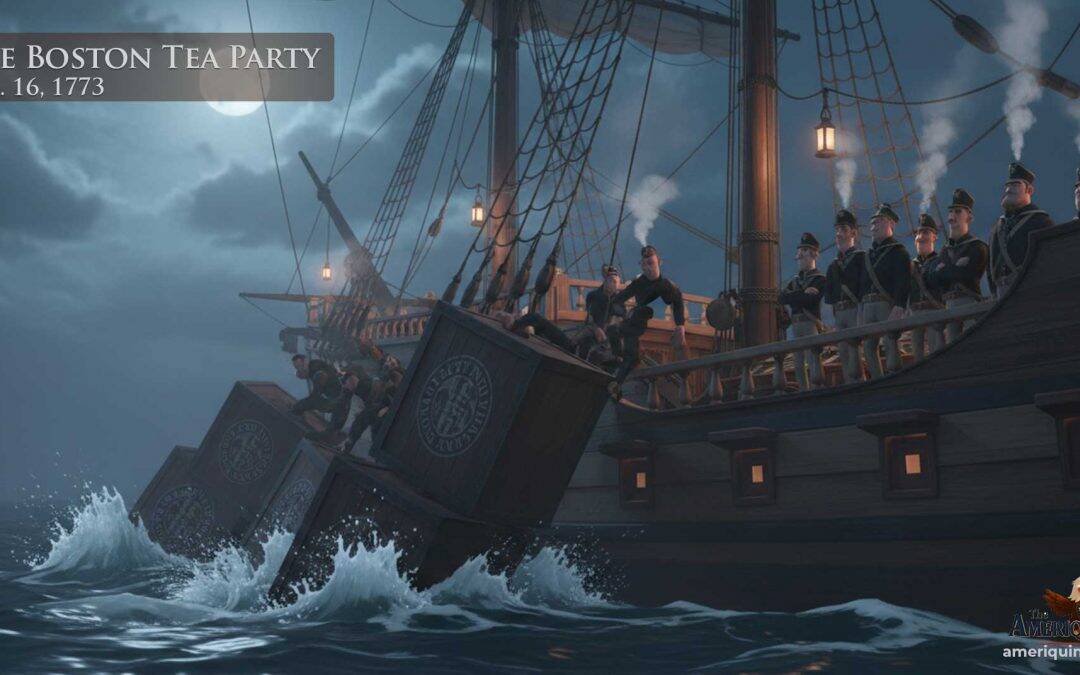
They marched to Griffin’s Wharf, boarded the three ships, and got to work.
In organized teams, they smashed open 342 chests of tea and dumped the contents into the harbor—tens of thousands of pounds destroyed in hours.
The tea was valuable.
The destruction was intentional.
This wasn’t theft—it was public defiance.
What’s striking is the discipline: they avoided damaging other cargo or attacking sailors.
When small items were accidentally broken, they were repaired or replaced.
The focus was surgical: the tea was the target because the tax—and the tyranny behind it—was the target.
How They Succeeded: Strategy Over Force
How did colonists destroy massive cargo under the British Empire’s nose?
Planning and networks. Patriot groups had built communication channels and learned to mobilize fast.
Speed and darkness. They acted at night as a unified force, making it difficult to stop in time.
Local support. Boston backed the resistance. When a city stands together, tyranny struggles to enforce control.
British hesitation. British commanders knew intervening could trigger bloodshed. If soldiers fired into crowds, it would turn the situation into a massacre and make resistance even more justified. The patriots avoided attacking people, denying Britain clear justification for violence.
Bottom line: the colonists won through discipline, public support, speed, and Britain’s fear of escalating too soon.
The Location: Boston—Epicenter of Freedom
The Boston Tea Party happened in Boston, Massachusetts, at Griffin’s Wharf on Boston Harbor, with political buildup at the Old South Meeting House.
Boston wasn’t just any port—it was one of the most significant cities in North America and the most politically charged place in the colonies.
If a statement was going to be made, Boston was the stage.
King George’s Response: Tyranny That Backfired
From King George III’s perspective, this wasn’t a protest—it was lawless destruction and direct defiance.
The response wasn’t negotiation—it was punishment.
In 1774, Parliament passed harsh measures known in Britain as the Coercive Acts, called in the colonies the Intolerable Acts:
- Closing Boston Harbor until the tea was paid for
- Crushing Massachusetts self-government and increasing royal control
- Restricting local political activity
- Strengthening British military presence
Britain hoped to isolate Boston and make Massachusetts an example.
The result was the opposite: other colonies saw these punishments as threats to everyone.
Sympathy and aid flowed to Boston.
Colonial leaders coordinated more formally, driving intercolonial unity that would become revolution.
This is why the Boston Tea Party was a major step toward war: it provoked a response so heavy-handed that it convinced more colonists the conflict wasn’t about one tax.
It was about whether Americans would live as free people—or submit as subjects.
Lessons for Americans Today: Courage, Consequences, and Freedom
For students and citizens, the Boston Tea Party isn’t just history—it’s a blueprint for defending liberty.
Rights require action. The colonists didn’t just complain.
They organized, debated, and acted.
That’s civic duty—something every generation must embrace.
Effective protest is disciplined.
The Tea Party wasn’t random violence.
It was a targeted statement focused on injustice. The discipline is why it mattered.
Actions have consequences—sometimes massive ones. The colonists knew this could bring punishment.
It did.
The lesson: understand the cost of your choices and be willing to pay the price for freedom.
Tyranny responds to pressure—but not always wisely. King George’s crackdown teaches another lesson: force often backfires.
When leaders refuse to listen and respond only with oppression, they widen conflict instead of ending it.
A Harbor Full of Tea—and a Point of No Return
On December 16, 1773, Boston Harbor became more than water.
t became a line in the sand. The Boston Tea Party didn’t start the Revolutionary War alone—but it made war inevitable by proving colonial resistance had moved from protest to defiance, and by triggering British actions that united the colonies in common cause.
That night, patriots didn’t just dump tea.
They dumped the illusion that tyranny could be resolved with polite appeals.
The consequences rolled forward—into congresses, boycotts, militias, and musket fire.
That’s why the Boston Tea Party still matters: it teaches that history changes when ordinary Americans decide their principles are worth more than their comfort—and when tyrants respond in ways that turn resistance into revolution.
From liberty’s first light, freedom demands vigilance.